
Garland Resident Lookup Records
A useful Garland resident lookup separates the kind of association shown by each record. The appraisal roll can identify an owner of record and a mailing address, but neither field proves occupancy. A recorded deed can identify parties and a legal description. A court portal can show a case indexed under a name, not a current location or an outcome without reviewing its docket. Start with the question, then keep the source date beside every result.
| Record | What It Confirms | Where | Access |
|---|---|---|---|
| Appraisal parcel | Owner-of-record, situs, mailing distinction, account and legal description | DCAD address and owner search | Online search, counter, phone, or written open-record request |
| Recorded instrument | Party role, document number, dates and legal description | Dallas County Official Records Search | Index online, then recording counter or document-request form |
| Court index | Case number, court, party role, filing and status fields | Dallas County Odyssey | Public portal and clerk route, subject to protected records |
| Voter registration | Registration information available under Texas law | Texas voter-registration tools | Lookup and county or state request routes with display limits |
| Vital event | An eligible verification or certified event record | Texas DSHS Vital Statistics | Index, verification, eligible application, county or district clerk |
Dallas County is the primary route for Garland, but some addresses lie in Collin County. Confirm the parcel county before treating a city mailing label as a custodian answer. MyGarland can supply city-limit and parcel context, while DCAD supplies the appraisal record for most Dallas County parcels. The two tools serve different purposes and should be cited separately.
Note: Treat a missing online result as a reason to check the named custodian and record group, not as proof the record does not exist.
Garland Resident Lookup Sequence
Use one verification sequence rather than a broad name search. Write the name in a normalized form, then retain a middle initial, middle name, former surname, alternate spelling, street number, street type, ZIP, and likely county as separate search notes. Those details make it possible to test a possible match without turning an unverified variation into a claim about the person.
- Search DCAD by address and owner. Save the account, situs, legal description, appraisal-year context, and the difference between owner and mailing fields. If the property is in Collin County, use the county that holds the parcel.
- Use the Dallas County recorder index for grantor, grantee, document type, dates, and legal description. Record party role and document number, because an owner, lender, trustee, and occupant are not the same role.
- Search Odyssey with the name in Last, First Middle order. Compare the court location, case number, filing date, status, and any available disposition before treating a match as the same person.
- Use the voter route only with the correct Dallas or Collin county and only within its lawful public fields. A registration entry can be a dated corroborating layer, not a full address export.
- Use DSHS or the filing clerk for a vital event only when the event date and requester eligibility fit. For a historical lead, turn to directory years, newspaper microfilm, census, Sanborn maps, deed books, or probate records.
End with a dated description of the evidence, such as “recorded party on an instrument,” “directory listing in a named year,” or “case index hit filed on a date.” That wording preserves what the record actually says.
- Docket
- A court’s running case record, often showing filings, hearings, status, and disposition. It is more useful than a bare name hit, but may still omit protected material.
- Index and image
- An index is a searchable list of record fields. An image is the scanned document itself. An index may identify an instrument while the image, access rules, or a request establishes the document detail.
- Certified copy
- A copy issued and certified by the custodian. It is different from an online screen or ordinary image and may require a fee or eligibility review.
Garland Odyssey Resident Lookup
Dallas County Odyssey Smart Search is the main county court route for a Garland name or case search. Its guide shows a required record number or name field, with names entered as Last, First Middle. Court Location can be set to All Locations. The Search By menu includes Smart Search, attorney and business routes, case cross-reference number, case number, and citation number. The hearing search adds location, hearing type, search type, optional Sounds Like matching, criteria, and a date range.
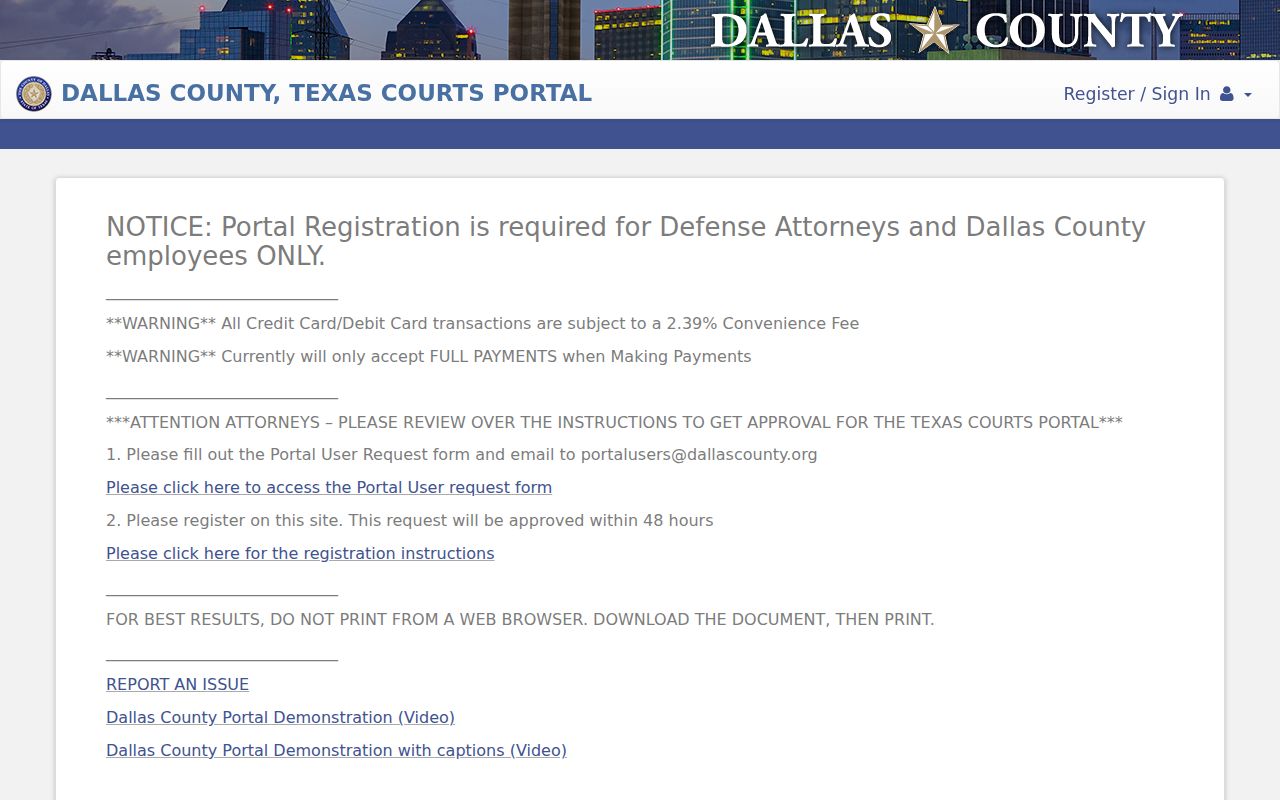
The portal image illustrates the entry route, not a resident result. Use the interface to narrow a case, then capture the case number, court, case type, party role, filed date, hearing date, and status from the current record. The District Clerk reports online civil cases back to 1975 with most files after 2008, and criminal cases back to 1975 with most felony documents after 2009. Coverage and document depth are not identical.
| Odyssey control | Use in a name check |
|---|---|
| Record Number or Name | Enter a record number or a name in Last, First Middle order. |
| Court Location | Select a location or All Locations before narrowing further. |
| Search By | Choose Smart Search, case number, citation number, or another listed route. |
| Hearing search | Use location, type, criteria, optional Sounds Like control, and date range. |
Sealed, confidential, juvenile, child, victim, and other protected material may not appear. A court index result is a prompt to inspect the docket or ask the correct clerk, not proof of residence, identity, guilt, or present status.
Note: Save a case number and court location before contacting a clerk, because the case custodian can differ from a general county office.
Garland Municipal Lookup Fallback
For a Garland municipal case that is not available online, use the Municipal Court records request form. It asks for the defendant name, citation number, defendant ID or driver-license number, date of birth, offense date, a detailed description, and requester contact. Delivery can be by email, mail, fax, or pickup. The stated copy fee is $0.10 per page, and the city asks requesters to allow up to ten business days. Its online services page also reports a system migration that has temporarily limited some online options.
Garland Police Records Division uses a different route for incident and police records. Its public request guidance calls for requester identity and, when known, the date of birth, date range, individual name, location, and time. Most information is stated as available within ten business days, subject to statutory exceptions and review.
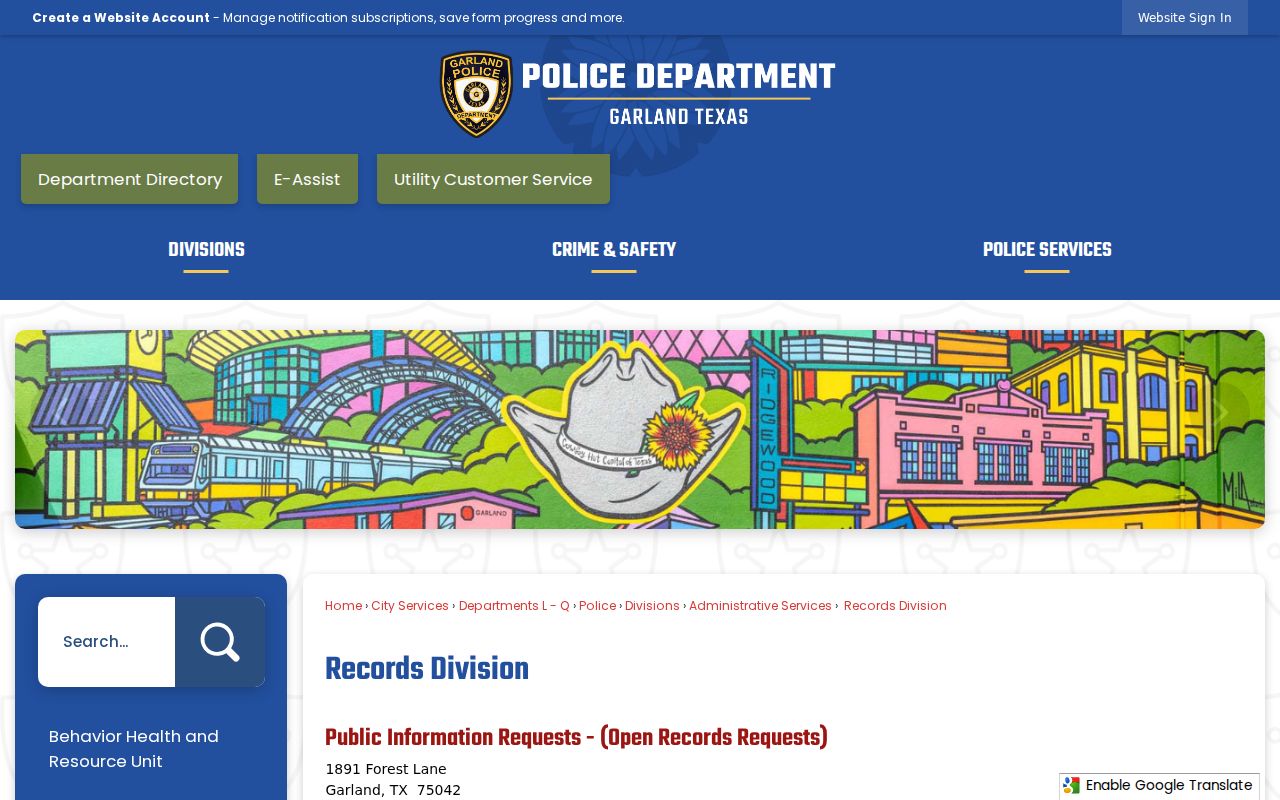
The police request channel can help locate an existing incident record. It is not a list of residents, and protected victim or juvenile material may be withheld. Keep the request narrow by record type, date range, and department.
Texas Public Information Act requests go to the governmental body that holds an existing administrative record. Judicial records follow Texas Rule of Judicial Administration 12 and the court custodian instead. The City of Garland public-information route is appropriate for a city administrative record, while a court docket or municipal court file belongs with the court form, clerk, or Rule 12 process.
When a Dallas County result is blank, use the relevant in-person terminal, phone confirmation, mail form, or central-records room. The county’s 2026 temporary Central Records notice says email requests are unavailable and some probate, civil, and criminal ranges are in person or temporarily unavailable. A PIA request can seek an existing nonjudicial record, but it cannot create a new resident list.
Garland Voter Lookup Limits
Texas voter tools use name, county, date of birth, and ZIP as lookup inputs, and a VUID may display. The statewide voter list is maintained through the Secretary of State and county registrars, but a Garland mailing label alone does not establish whether Dallas or Collin County controls the registration. The City of Garland contracts with both counties for election services, so confirm the address before choosing a county route.
Public web display is narrower than a formal voter-list request. Texas law protects Social Security numbers, driver-license and DPS ID numbers, and ballot choices. Website displays may also suppress residential addresses. Every voter may ask for residential-address suppression, and qualifying participants in the Texas Address Confidentiality Program can use a substitute address. A missing address is not proof that a registration does not exist.
Voter registration shows registration at a time, not current occupancy. Record only the field that is lawfully visible and relevant, then use an independent record type for confirmation.
Garland Vital Record Eligibility
DSHS Vital Statistics separates birth, death, marriage, and divorce routes. Texas Government Code §552.115 opens birth records on the 75th anniversary of birth and death records on the 25th anniversary of death. Recent certified copies are limited to qualified requesters, including the named person, immediate family, guardian, legal agent, or another person with the required tangible-interest documentation. The office can require acceptable identification and supporting material.
DSHS publishes statewide vital-statistics guidance from 1903 forward, while Dallas County Clerk may provide eligible birth and death records filed in Dallas County cities other than the City of Dallas. A DSHS marriage or divorce verification is not a certified license or decree. Obtain a certified marriage license from the county clerk that issued it and a certified divorce decree from the district clerk where it was filed. For an older Garland lead, library newspapers and directories can point to an event, but they do not replace a certified record.
Use the current form and fee schedule before ordering. A death application can require requester and decedent information, relationship or eligibility, ID, payment, delivery choice, signature, and supporting evidence. DSHS procedures include online, mail, walk-in, and expedited routes depending on the product and current form. Do not place full dates of birth, identification numbers, or restricted relationship papers into a resident lookup note.
Note: An index or verification can guide historical work, but the current DSHS form and issuing clerk control an eligible certified request.
Garland Historical Lookup Sources
When the question concerns a past household instead of a current record, Central Library is the local starting point. Its genealogy and local-history service has Garland newspaper microfilm from 1900 to 2000, Dallas Morning News microfilm from 1972 forward, specialized reference holdings, HeritageQuest remote access for Garland cardholders, and interlibrary loan. A historic notice should be checked against a directory, deed, census, or vital source before it is treated as a person-place match.
Texas State Library city-directory research, UNT’s digitized collections, and UT Austin’s Garland telephone-directory citation provide further routes. The telephone-directory run spans 1955 through 1999 with gaps and includes nearby communities, so it is not a city-only residence list. Preserve the year, page or image, city label, and whether a result came from OCR or a page image.
Garland Resident Lookup Boundaries
Texas records have limits even when an index is public. Living persons’ dates of birth, driver-license numbers, license plates, financial information, juvenile material, victim information, and certain official home or family details can be withheld or redacted. Courts may seal or restrict records. A parcel owner is not necessarily an occupant, a court filing is not a finding of guilt, and a historical directory listing does not establish a current address.
If a record seems wrong, note the exact source, date, record role, and field at issue, then contact the custodian. The County Clerk controls a recorded instrument, a registrar controls voter data, and a library or archive controls its scan. Keeping those roles separate avoids claiming more than the record supports.